River Drill Put Crews to the Test
Practice means being prepared – for river spills
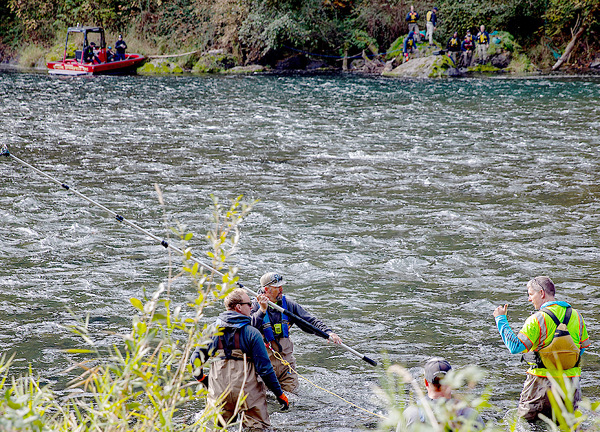
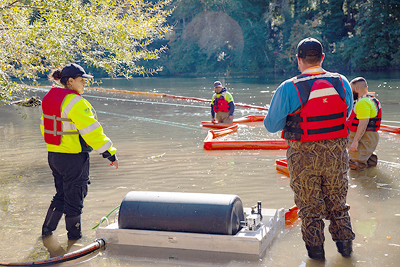
Emergency responders from more than a dozen agencies gathered at Hendricks Bridge County Park near Walterville on Wednesday, Oct. 14, to practice containing hazardous spills in the McKenzie River, building on lessons learned from an actual tanker truck accident earlier this year.
The annual exercise, coordinated by the Eugene Water & Electric Board (EWEB), brought together firefighters, watershed scientists and hazardous materials specialists to practice protecting the river that supplies drinking water to more than 200,000 Eugene and Springfield residents.
Working in the river’s current, crews deployed floating containment booms designed to intercept oil and other surface pollutants before they could reach EWEB’s Hayden Bridge Water Treatment Facility downstream.
The operation required teams to stretch ropes across the river to position and control the booms, directing floating contaminants toward equipment capable of removing them from the water.
The training was particularly relevant following a May 15 accident near Trail Bridge Reservoir, when a milk tanker crashed in the Upper McKenzie watershed, releasing both milk and diesel fuel.
The accident occurred around 4:30 a.m., and Upper McKenzie Rural Fire Protection District personnel arrived within 30 minutes to initiate emergency spill response procedures.
EWEB and its emergency response partners subsequently deployed containment equipment at the same location where they had practiced during an October 2025 drill.
While the booms helped intercept diesel fuel, the milk dispersed into the river and could not be collected using the same equipment.
EWEB officials said the incident demonstrated the importance of maintaining equipment, training personnel and establishing working relationships among responding agencies before an emergency occurs.
“When a milk tanker crashed and spilled milk and diesel into the Upper McKenzie this past May, EWEB and partners rapidly deployed a containment system at the same location that we drilled in October of 2025,” said EWEB Water Resources and Quality Assurance Supervisor Susan Fricke. “Our collective response once again proved our readiness to respond to incidents.”
David Donahue, EWEB’s senior environmental specialist and spill drill coordinator, emphasized that the exercises are as much about communication and coordination as handling equipment.
The annual drills help emergency responders maintain contacts, become familiar with specialized equipment and practice strategies for different types of spills.
The participating agencies are members of the McKenzie Watershed Emergency Response System (MWERS), a coordinated network established to protect the watershed from hazardous material releases.
Participants include McKenzie Fire & Rescue, Eugene-Springfield Fire Hazmat, the Lane County Sheriff’s Office, Springfield Utility Board, the City of Springfield, Oregon Department of Environmental Quality and the U.S. Forest Service, among others.
The system uses detailed watershed maps identifying predetermined locations where crews can deploy containment equipment. These sites allow responders to intercept pollutants before they travel farther downstream.
Hendricks Bridge County Park is one of those strategic locations. Situated upstream of EWEB’s drinking water intake, the park offers a boat ramp for launching support vessels, parking for emergency vehicles and stretches of river shallow enough for crews to work in the water.
For more than 25 years, EWEB and its community partners have coordinated efforts to protect McKenzie River water quality. The annual spill drill is a central part of that preparation.
The utility is also pursuing plans for a second water treatment plant on the Willamette River, which would provide an alternative drinking water source should contamination or another emergency disrupt supplies from the McKenzie.
For residents along the river, the exercise serves as a reminder that accidents upstream can have consequences far downstream – and that a rapid, coordinated response can make a significant difference.
Anyone observing an actual spill in the McKenzie River can report it to the Oregon Emergency Respons
Author